
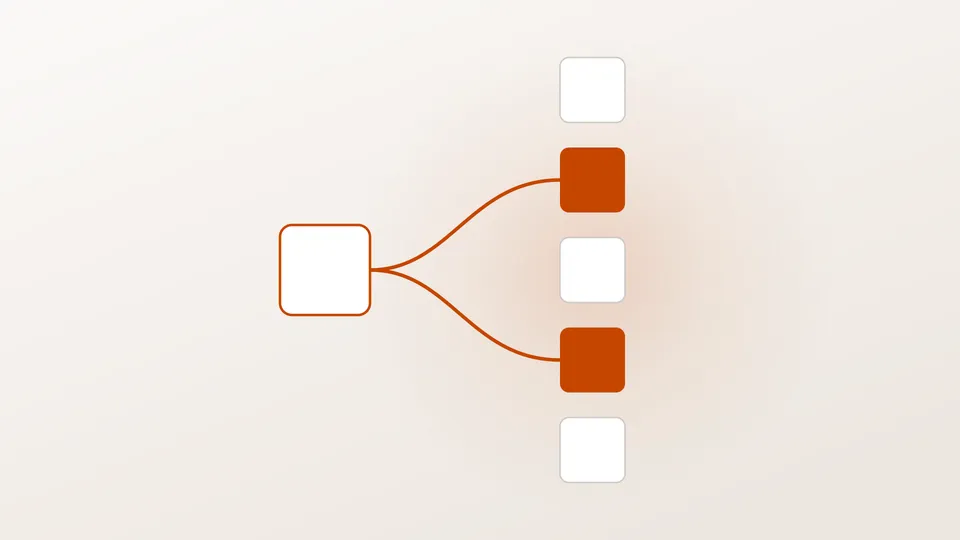
In September someone merged a layout fix that touched the shared UI package in one of our monorepos. CI went green and the staging sites updated. Three of the five apps that use that package kept serving the old code, and nobody noticed.
We only found out in November. By then we had moved the repository to tallyrelease and were going back through CI history to see how much build time the switch had saved. It saved less than we hoped. The history turned up the missed rebuilds instead.
What “build what changed” meant before
The repository is a typical web monorepo: five apps, a few shared packages, one CI pipeline. Every push to main builds a container image per app and rolls it out to staging.
Building every app on every push is slow, so we never did that. We let the release tool decide. Release-please kept one release PR per app open, and on each push CI rebuilt every app that had unreleased changes. In practice that meant “build whatever hasn’t shipped yet”, which overlaps with “build what changed” less than you’d think.
The other half of the problem was how release-please decides an app has changed. It matches commits to folders. A commit under apps/web belongs to apps/web. A commit under packages/ui belongs to no app at all, because packages/ui isn’t released. Any app that imported it was never picked up.
What the history showed
We replayed every push to main from the two months before the switch and the five weeks after. For each one we compared two lists: the apps CI built, and the apps whose code or dependencies had actually changed since the last successful run. Each push landed in one of three buckets.
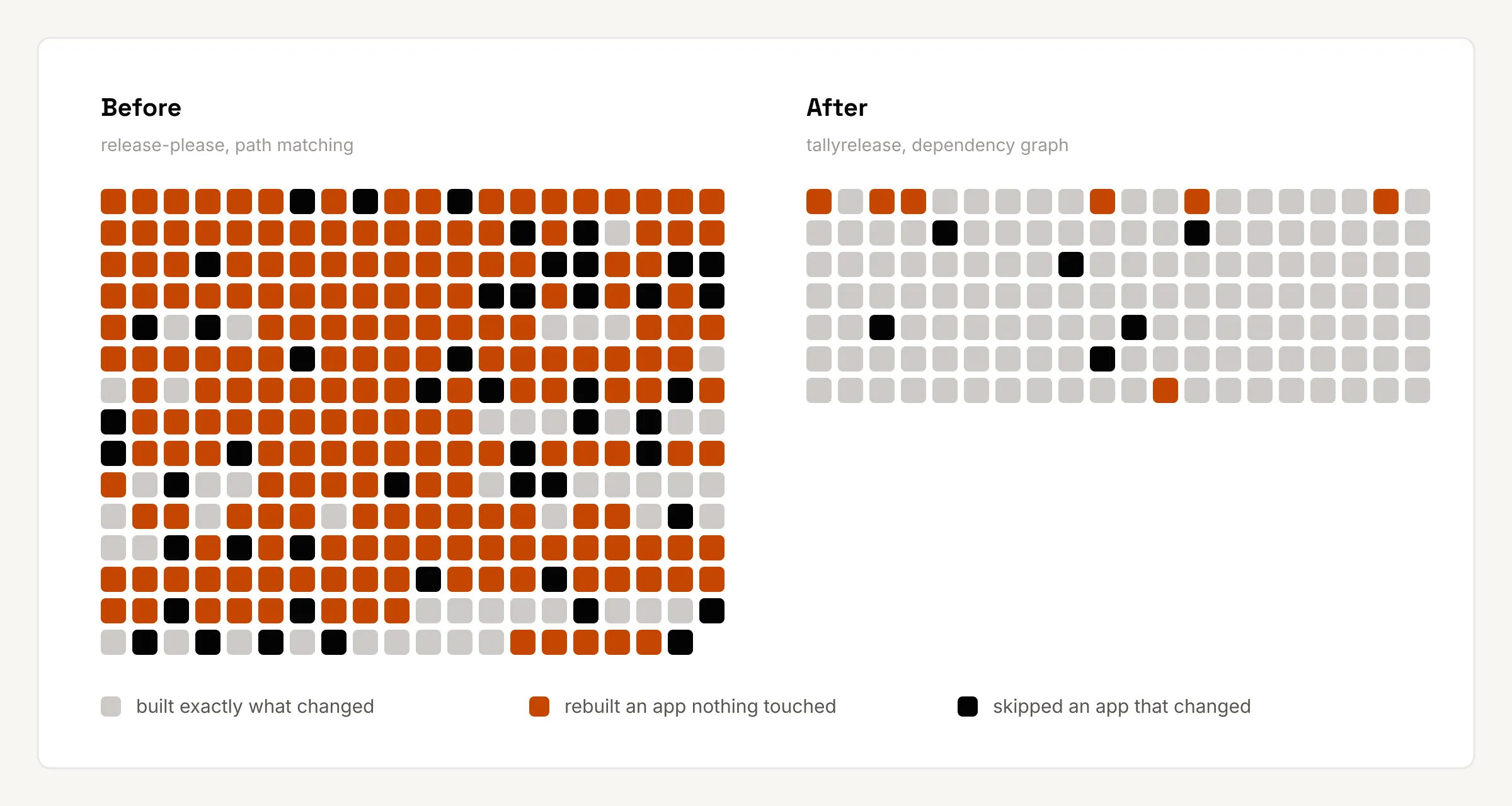
The orange was the waste we expected. Most pushes rebuilt at least one app nobody had touched, because an app with an open release PR came along on every merge until someone shipped it. Those release PRs often stayed open for days.
The black squares were the surprise. About one push in six skipped an app that should have been rebuilt. Most of them came from changes to shared packages or dependencies. The September UI fix is one of those black squares.
Neither problem made noise. The waste looked like normal CI time. The misses looked like nothing at all, because the build you skip doesn’t fail. Staging kept serving an older build of an app, and it stayed that way until the next commit to that app’s folder happened to trigger a rebuild.
Same work, half the builds
After the switch, nine pushes in ten built exactly what had changed. The few that didn’t were mostly on the day of the switch or came from dependency bumps, where you could argue either way about whether a rebuild was needed.
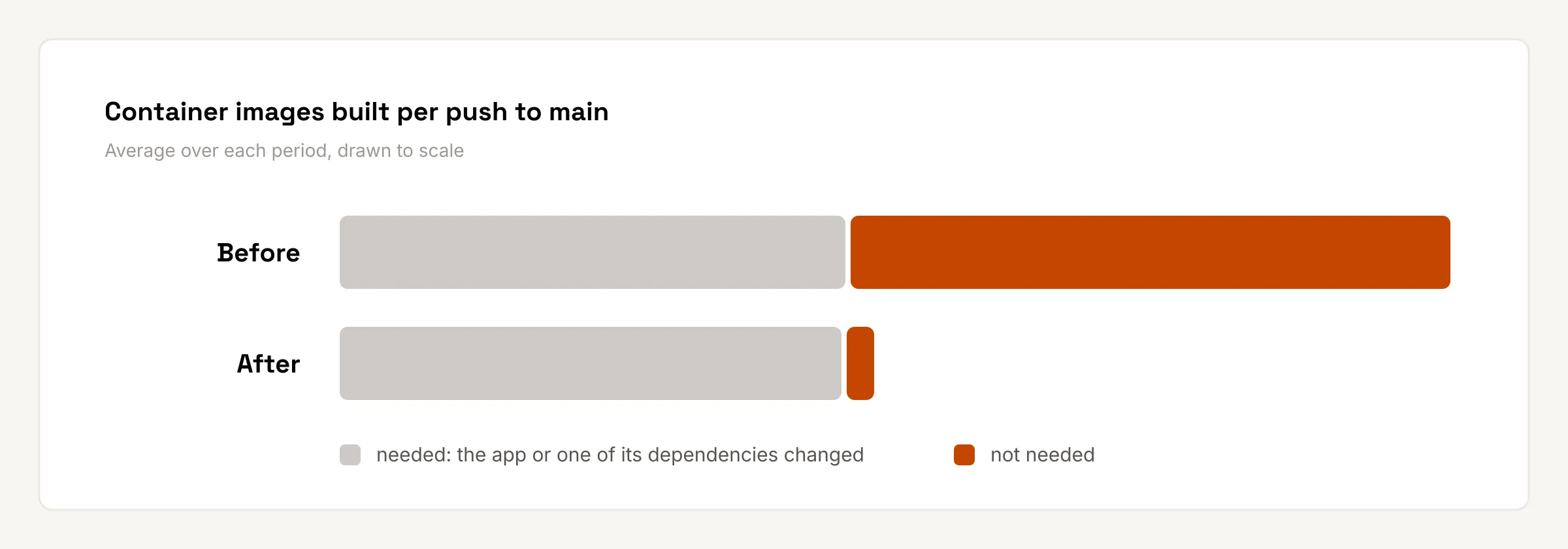
The grey part of both bars is almost the same length. The amount of real work per push didn’t change, because we kept shipping at the same pace. What went away was the orange: more than half of all the images built before the switch weren’t needed.
Our pipeline didn’t get noticeably faster, though. Image builds already ran in parallel, so dropping the extra ones saved compute minutes but not wall clock time. A push took about as long before as after. With five apps that is a fair result. With fifty apps and a shared runner pool, the extra builds start queuing behind each other, and then the same waste shows up as time.
Why the graph matters more than the speed
Affected builds are usually sold on speed. Most writing about nx affected, Turborepo filters and monorepo CI in general measures success in minutes saved, and that is the second thing I’d check.
There are two ways to get “what changed” wrong. Build too much and you pay in compute, which everyone can see on the bill. Build too little and you ship stale code, which no dashboard reports. Path filters, paths: triggers in GitHub Actions, and folder-based release tools all fail in the second direction as soon as you have shared code, because they don’t know what depends on what.
A dependency graph does. tallyrelease reads it from the workspace, so a change to packages/ui selects every app that imports it, directly or through another package. The same graph decides which apps get a release, so the build list and the release list can’t disagree.
If you’re deciding whether this applies to you, check these:
- Shared internal packages. If apps import code from outside their own folder, path matching will miss some changes.
- Release PRs that stay open. If CI selection depends on unreleased changes, every open release PR adds builds to every merge.
- Staging deployed from
main. A missed rebuild only matters if something runs the old build. If staging does, someone will test against stale code eventually. - Lots of dependency bumps. Automated bumps touch lockfiles and manifests. Decide on purpose whether they rebuild everything, and write that rule down.
If none of these apply, folder filters are fine. If two or more do, the graph is worth it.
Appendix: how we measured it
The data. Every push to main in two windows: about two months before the switch and five weeks after. A two-week window during a CI migration is left out, because image publishing wasn’t fully wired up then and would have skewed the comparison.
What counts as changed. For each push we diffed against the last successful run, not the parent commit, since that’s the range a real pipeline has to cover after a cancelled or failed run. An app counted as changed if a file in its folder changed, if a shared package it depends on changed, or if a repository-wide input like the lockfile changed. Files the release config ignores, such as docs and CI config, didn’t count. If you only count source changes, the old setup’s misses drop by about half, and the new one looks wasteful on dependency bumps, because it rebuilds every app a bump touches. We’d take that trade: an extra rebuild costs a few minutes, a missed one costs a stale staging site.
What we didn’t measure. Test selection, remote caching and pull request checks. Our PR pipeline runs the full check on every change, which is a separate decision.